Blood Diamonds, Open Pits and the Lab: Are Lab-Grown Diamonds Really the Ethical Choice?
Most people start thinking about where a diamond comes from at roughly the same moment they start shopping for one. You type "engagement ring" into a search bar, and three clicks later you're reading about civil wars, child labour and open pits you can see from space. Then the next tab tells you lab-grown diamonds are "100% eco-friendly" and the problem is solved.
Neither tab is giving you the whole picture. So I went through the actual reports, including the ones paid for by the mining industry and the ones paid for by lab-grown producers, to answer one question: are lab-grown diamonds really the more ethical, more environmentally friendly choice?
The short answer
Yes, on most counts, with one honest caveat. A lab-grown diamond involves no mining, moves no earth, and cannot fund an armed conflict, and its origin is far easier to trace. The caveat is energy: growing a diamond takes a lot of electricity, so its carbon footprint ranges from very low (renewable power) to higher than a mined diamond (coal-heavy grids). The greenest diamond is a lab-grown one made with clean energy, so it's worth asking how yours was made.
Key takeaways
- Blood diamonds were real, and deadly. Diamond-funded wars in Sierra Leone, Angola, Liberia and the DRC killed and maimed huge numbers of people in the 1990s and early 2000s.
- The Kimberley Process helped, but has gaps. It only covers diamonds that fund rebel groups, not abuses by governments or companies, and two of its founding NGOs have walked away.
- Mining is physically enormous. Estimates start at around 250 tonnes of earth moved for a single carat.
- Lab-grown diamonds are real diamonds. Same carbon crystal, same hardness, same sparkle.
- The carbon question depends on the power source. Published figures run from about 17 kg to over 500 kg of CO₂ per carat for lab-grown, against roughly 57 to 160 kg for mined.
- Buyers have already moved. Lab-grown stones were in 51% of newly appraised engagement rings in the first half of 2026.
What is a blood diamond?
A blood diamond, also called a conflict diamond, is a diamond mined in a war zone and sold to finance an insurgency, an invading army or a warlord. The term became common in the late 1990s, when journalists and campaigners showed that rough diamonds were paying for some of the most brutal wars in modern Africa.
The best-known example is the Sierra Leone Civil War (1991 to 2002). A rebel group, the Revolutionary United Front, seized the country's diamond fields and used forced labour to dig them. The stones, worth an estimated $125 million a year, were traded for weapons. The war killed around 50,000 people, and the RUF became notorious for amputating the hands and arms of civilians, along with mass rape and the abduction of children as soldiers.
It wasn't a one-off. Diamonds also helped fund:
- Angola's long civil war, where the rebel movement UNITA sold diamonds to keep fighting.
- Liberia's wars, where President Charles Taylor supplied Sierra Leone's rebels with weapons in exchange for diamonds. In 2012 he was convicted of war crimes and sentenced to 50 years in prison.
- Conflicts in the Democratic Republic of the Congo, Côte d'Ivoire and, more recently, the Central African Republic, which was suspended from the certified diamond trade in 2013.
At the peak of these wars, in 1999, conflict diamonds were estimated to make up about 4% of the world's diamond production. That sounds small until you remember what that 4% was paying for.
Did the Kimberley Process fix the problem?
Partly. The Kimberley Process Certification Scheme started in 2003. It requires member countries to certify that shipments of rough diamonds are conflict-free, and it bans trade with non-members. Today it has 59 participants representing 85 countries, and it is credited with cutting conflict diamonds to under 1% of global production. That is a real achievement, and it's worth saying so.

Countries participating in the Kimberley Process. Image: Aglaja, Wikimedia Commons, public domain.
But "conflict-free" has a much narrower meaning than most shoppers assume. Under the Kimberley Process, a conflict diamond is one that finances a rebel movement fighting a recognised government. That definition leaves out a lot:
- Abuses by governments. When Zimbabwe's military took over the Marange diamond fields, human rights groups documented killings and forced labour. The scheme still approved Marange exports in 2010, because the violence wasn't committed by rebels.
- Child labour, unsafe conditions and unfair pay. None of these are covered. Human Rights Watch has called the scheme "too narrow in scope."
- Environmental damage. Not covered at all.
- Smuggling and fake paperwork. Certificates apply to parcels of rough stones, not individual diamonds, so stones can be mixed or moved across borders before they're certified.
The people who helped build the scheme have noticed. Global Witness, the campaign group whose work led to the Kimberley Process in the first place, left it in 2011, saying it no longer gave buyers assurance that diamonds were conflict-free. A second founding NGO, IMPACT, followed in 2017. And since 2022 members have argued over whether Russian diamonds should count as conflict diamonds, without reaching agreement.
So when a jeweller says a mined diamond is "Kimberley certified," that tells you it probably didn't fund a rebel army. It doesn't tell you who dug it, what they were paid, or what the land looks like now.
What does diamond mining do to the environment?
Diamonds are rare in the rock that carries them, which means mining them is mostly a matter of moving rock. A 2020 review by a researcher at Imperial College London, Environmental Impacts of Mined Diamonds, pulled together the published numbers. For a single carat of mined diamond, it found:
| Impact, per carat mined | Reported range |
|---|---|
| Earth and rock moved | 250 to 1,750 tonnes |
| Water used | 0.48 to 7.3 cubic metres (480 to 7,300 litres) |
| Energy used | 52 to 150 kWh |
| Carbon footprint | 57 to 160 kg CO₂e |
| Land used | 100 to 272 square feet |
The first row is the one that stays with me. A one-carat diamond weighs a fifth of a gram. Getting it out of the ground means shifting at least 250 tonnes of earth, which is more than the weight of a blue whale.

The Mir diamond mine in Yakutia, Russia, one of the largest excavated holes on Earth, with the town of Mirny at its edge. Photo: Staselnik, Wikimedia Commons, CC BY-SA 3.0.
What that looks like on the ground depends on the type of mine:
- Open-pit mines remove whole landscapes. The Mir mine in Russia is more than 500 metres deep and over a kilometre wide.
- Alluvial mining, which digs up riverbeds and floodplains, is common in West and Central Africa. It can strip topsoil, silt up rivers and leave thousands of small abandoned pits that fill with stagnant water.
- Marine mining, used off the coast of Namibia, vacuums sediment from the seabed.
- Waste rock and tailings have to go somewhere, and they can leach into soil and groundwater for decades.
In fairness, the big industrial miners are not the worst offenders here. Large companies in Botswana, Canada and Australia operate under strict environmental rules, restore land, and fund schools and hospitals. An industry-commissioned report from 2019 put the net socio-economic benefit of the major miners at $16 billion. Botswana in particular is often held up as a country that mining helped lift out of poverty. Those benefits are real, and any honest comparison has to include them.
The trouble is that when you buy a mined diamond in a shop, you usually can't tell which kind of mine it came from.
What is a lab-grown diamond, exactly?
A lab-grown diamond is a real diamond. It's pure carbon in the same crystal structure as a mined stone, with the same hardness (10 on the Mohs scale), the same brilliance and the same durability. It is not cubic zirconia and it is not moissanite, which are different materials. As the Wikipedia entry on synthetic diamond explains, the first reproducible process was demonstrated back in 1954, but gem-quality stones at jewellery sizes only became affordable in the last decade.
There are two ways to grow one:
- HPHT (high pressure, high temperature). A small diamond seed is placed in carbon and squeezed in a press at extreme pressure and heat, copying the conditions deep in the Earth.
- CVD (chemical vapour deposition). A seed sits in a chamber filled with carbon-rich gas. The gas is energised into plasma, and carbon settles onto the seed layer by layer.
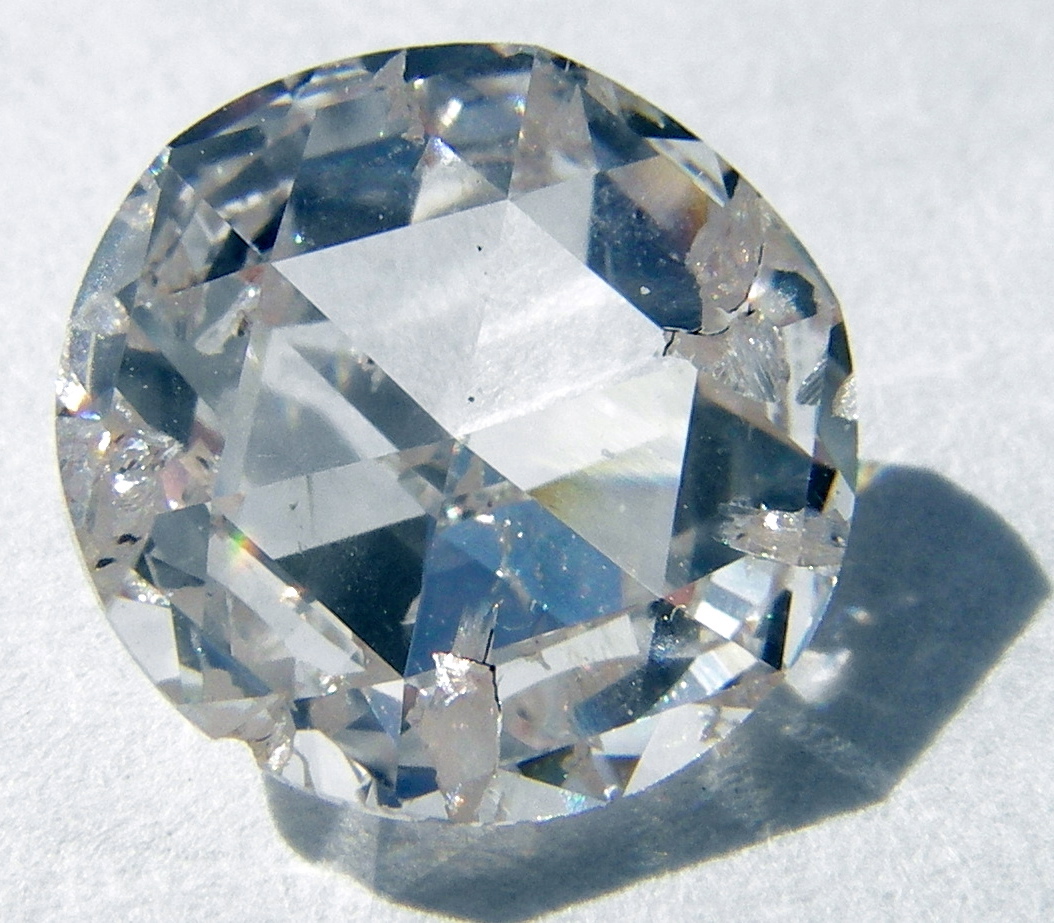
A gem-quality diamond grown by chemical vapour deposition. Photo: Steve Jurvetson, Wikimedia Commons, CC BY 2.0.
Regulators agree these are diamonds. In 2018 the US Federal Trade Commission removed the word "natural" from its definition of a diamond, and said that calling a competitor's lab-grown stones "synthetic" to suggest they aren't real diamonds is deceptive. Gem labs such as IGI and GIA grade them, and even a trained jeweller can't tell a lab-grown stone from a mined one without specialist equipment.
Are lab-grown diamonds better for the environment?
This is where I have to be careful, because it's where both sides of the industry stretch the truth.
Where lab-grown clearly wins
- No earth moved. There is no pit, no waste rock and no riverbed dug up. A growing facility is a building.
- Far less land and water. There are no tailings dams and no disturbed ecosystems to restore.
- No conflict financing. A diamond grown in a reactor cannot pay for a rebel army.
- A short supply chain. A lab-grown diamond goes from grower to cutter to jeweller. A mined diamond can change hands a dozen times across several countries.
Where it's complicated: carbon
Growing a diamond takes a lot of electricity, and the carbon footprint depends almost entirely on where that electricity comes from. More than 60% of lab-grown diamonds are made in China and India, where coal still supplies well over half of grid power. Here are the published numbers, with who paid for them:
| Diamond type | CO₂ per polished carat | Source |
|---|---|---|
| Lab-grown, renewable energy | about 17 kg | Sphera, reported by Rapaport (2023) |
| Mined | 57 to 160 kg | Imperial College London review (2020) |
| Mined (large producers) | 160 kg | Trucost, commissioned by diamond miners (2019) |
| Lab-grown, coal-heavy grid | about 260 kg | Sphera, reported by Rapaport (2023) |
| Lab-grown (industry average estimate) | 511 kg | Trucost, commissioned by diamond miners (2019) |
Two things stand out. First, the highest lab-grown figure comes from a study paid for by the mining industry, whose authors admitted they struggled to get good data from growers. Second, even setting that aside, the range is huge: a lab-grown diamond made with renewable power can have roughly a tenth of the carbon footprint of a mined one, while one made on a coal grid can have more. As Rapaport's analysis put it, you can't make a simple general comparison.
That's also why the FTC sent warning letters to eight jewellery companies in 2019, telling them not to use blanket claims like "eco-friendly" or "sustainable" without evidence. It's a fair rule. If a brand tells you its diamonds are green, it should be able to tell you why.
The trend favours the lab
A mine's footprint is mostly fixed: the rock has to move. A grower's footprint falls every time the grid gets cleaner or a producer switches to solar, wind or hydro, and several large growers already have. So the gap is likely to widen in lab-grown's favour over time.
Mined vs lab-grown diamonds: side-by-side
| Mined diamond | Lab-grown diamond | |
|---|---|---|
| Is it a real diamond? | Yes | Yes |
| Conflict risk | Low today, but hard to rule out for an individual stone | None |
| Earth moved per carat | 250+ tonnes | None |
| Carbon footprint | Moderate, fairly fixed | Very low to high, depending on energy source |
| Traceability | Often limited to country or parcel | Usually traceable to the grower |
| Jobs in mining communities | Supports them | Does not |
| Median price per carat (2025) | $8,428 | $2,057 |
| Resale value | Some, usually well below retail | Very little |
The price row comes from insurer BriteCo's appraisal data, which also shows how quickly buyers have shifted: lab-grown diamonds made up 51% of newly appraised engagement rings in the first half of 2026, up from 5.9% in 2019.
How to buy a diamond you can feel good about
Whichever way you lean, these five questions will tell you more than any "ethical" badge on a product page.
- Is the origin stated plainly? A lab-grown diamond should be labelled as lab-grown right next to the product name. A mined diamond should come with a country, and ideally a mine, of origin.
- Is there an independent grading report? Look for IGI or GIA. Many lab-grown stones are laser-inscribed with a report number you can look up.
- What powers the growing facility? Ask. A brand that uses renewable energy will be glad to tell you. Vague answers are an answer too.
- What is the setting made of? Gold mining has its own footprint. Recycled gold or silver is a meaningful improvement.
- Does the brand make specific claims or vague ones? "Grown with 100% solar power" is checkable. "Eco-friendly" is not.
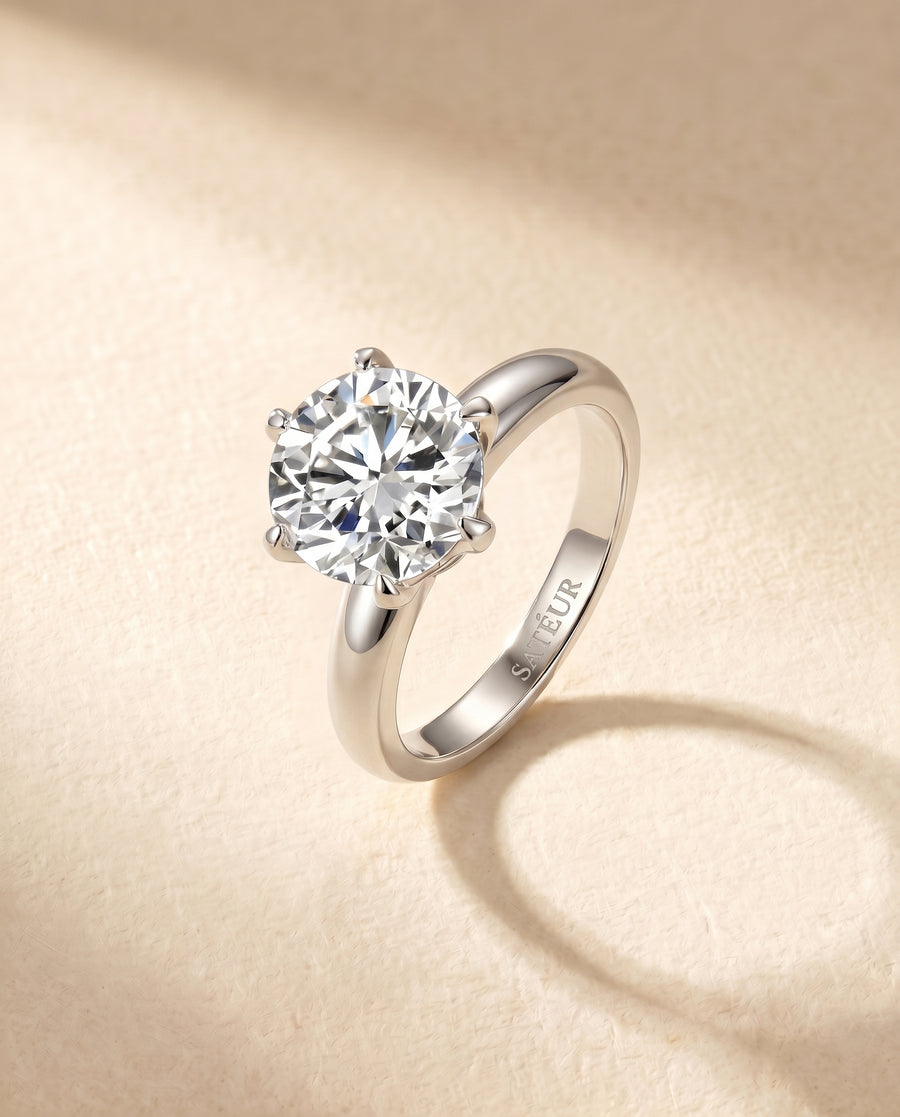
A lab-grown diamond solitaire in white gold. Image: Satéur.
If you'd like to see what lab-grown looks like in practice, including carat sizes that would cost several times more as mined stones, have a look at these lab-grown diamond engagement rings. And if a diamond isn't essential to you at all, Satéur also makes moissanite and diamond-simulant rings, which skip the question entirely.
Frequently asked questions
Are blood diamonds still a problem in 2026?
Much less than in the 1990s. Diamonds that fund rebel groups are estimated at under 1% of world production. But the official definition doesn't cover abuses by governments or mining companies, and certificates can't guarantee the history of an individual stone, so the risk for a mined diamond is low, not zero.
Are lab-grown diamonds real diamonds?
Yes. They have the same chemical composition, crystal structure, hardness and optical properties as mined diamonds. The only difference is that they form in weeks in a reactor, not over billions of years underground.
Are lab-grown diamonds better for the environment than mined diamonds?
For land, water and waste, yes, by a wide margin, because nothing is mined. For carbon, it depends on the electricity used. Lab-grown diamonds made with renewable energy have a much smaller carbon footprint than mined diamonds; those made on coal-heavy grids can have a larger one.
Are lab-grown diamonds conflict-free?
Yes. They are manufactured in facilities, not dug in conflict zones, so they cannot finance armed groups. That said, "conflict-free" doesn't cover everything, so it's still worth asking about working conditions and energy use.
Does "Kimberley Process certified" mean a diamond is ethical?
No. It means the rough diamond was certified as not funding a rebel movement. It says nothing about labour conditions, pay, government abuses or environmental damage.
Why are lab-grown diamonds so much cheaper?
Production has scaled up and the technology has improved, so supply has grown quickly. Median prices in 2025 were about $2,057 per carat for lab-grown against $8,428 for mined. The flip side is that lab-grown diamonds have very little resale value.
Do lab-grown diamonds hurt mining communities?
This is the strongest argument against them. Countries like Botswana rely on diamond revenue for schools, healthcare and jobs. If that matters most to you, a mined diamond with a documented origin from a well-regulated country is a reasonable choice.
The bottom line
The mined diamond industry is cleaner than it was 25 years ago, and the best of it supports whole economies. But it's still an industry where one small stone means hundreds of tonnes of moved earth, and where the certificate in the box doesn't cover most of the things people actually worry about.
Lab-grown diamonds remove the pit and the conflict risk, and they cost a fraction of the price. They aren't automatically green, because the electricity matters. But a lab-grown diamond from a grower using clean energy is, on the evidence, about the lowest-impact diamond you can buy today. For most people shopping for an engagement ring in 2026, that makes it the easier choice to feel good about.
Sources and further reading
- Blood diamond, Wikipedia
- Kimberley Process Certification Scheme, Wikipedia
- Environmental Impacts of Mined Diamonds, Dr Gbemi Oluleye, Imperial College London
- Diamond Miners Hit Back on Lab-Grown's Eco-Friendly Claims, JCK
- A Pair of Carbon Footprints, Rapaport
- Are lab-grown diamonds as sustainable as advertised?, ABC News
- FTC warning letters on diamond ad disclosures, US Federal Trade Commission
- Lab-grown diamonds reach 51% of newly appraised engagement rings, The Centurion
Comments
Post a Comment